


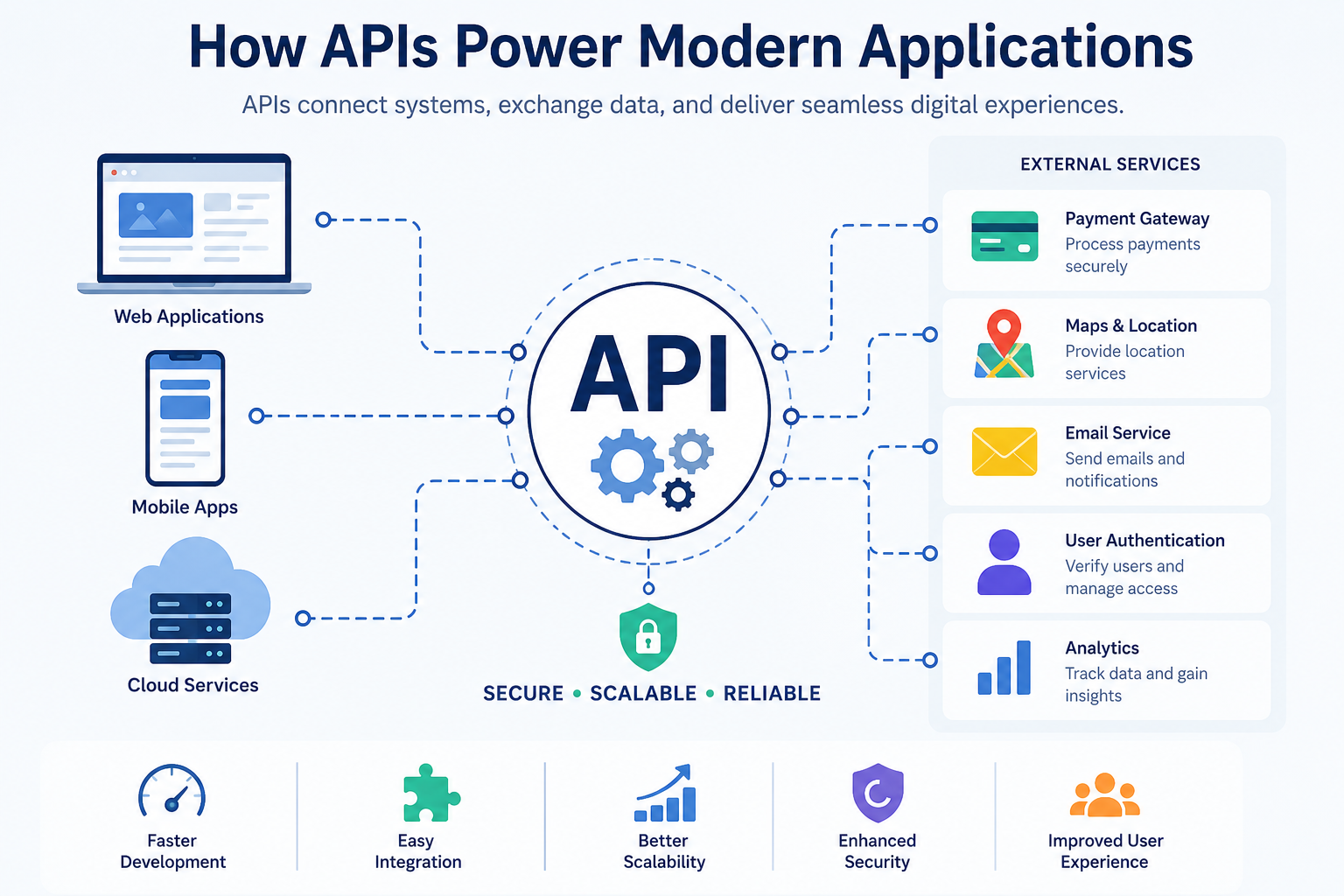
Modern applications depend on speed, flexibility, and seamless communication. Application Programming Interfaces, commonly known as APIs, make this possible by allowing different software systems to connect, exchange data, and perform tasks together.
An API acts like a digital messenger. It receives a request from one application, sends it to another system, and returns the required response. For example, when a food delivery app shows a map, processes an online payment, or sends a notification, it often uses APIs provided by mapping, payment, and messaging services.
APIs help developers build applications faster because they do not need to create every feature from scratch. Instead, they can integrate trusted services for login, payments, cloud storage, analytics, artificial intelligence, and more. This reduces development time, lowers costs, and allows teams to focus on creating a better user experience.
Another reason APIs power modern applications is scalability. As a business grows, APIs make it easier to add new features, connect additional platforms, and support more users. They also enable mobile apps, websites, and internal systems to share the same data securely and consistently.
Security is an important part of API development. Well-designed APIs use authentication, encryption, access controls, and usage limits to protect sensitive information. Regular monitoring and updates also help prevent misuse and improve reliability.
APIs are essential for digital transformation. They connect businesses with customers, partners, devices, and third-party services in real time. From social media platforms and e-commerce websites to banking systems and smart devices, APIs work behind the scenes to keep digital experiences connected.
They also support automation, helping organizations streamline workflows and reduce manual work.
In conclusion, APIs power modern applications by making software more connected, efficient, scalable, and innovative. Businesses that use APIs effectively can launch products faster, improve customer experiences, and adapt more easily to changing technology.
Common Types of APIs
Different APIs are designed for different purposes. REST APIs are widely used because they are simple, flexible, and easy to integrate with websites and mobile applications. SOAP APIs are often used in enterprise systems that require strict security and structured communication. Graph QL APIs allow applications to request only the data they need, which can improve speed and efficiency.
How APIs Improve User Experience
APIs improve user experience by helping applications deliver information quickly and accurately. They support real-time notifications, personalized recommendations, automatic updates, and seamless payment processing.
A well-integrated API reduces loading time and makes it easier for users to complete tasks. Reliable APIs also ensure that websites and applications continue to work smoothly as user demand increases.
Real-World Uses of APIs
APIs are used in many everyday digital services. E-commerce websites use payment APIs to process transactions securely. Travel applications use APIs to display hotel availability, flight prices, and maps. Social media APIs allow users to log in, share content, and connect accounts across different platforms.
These integrations help businesses add advanced features without building every service from the beginning.